
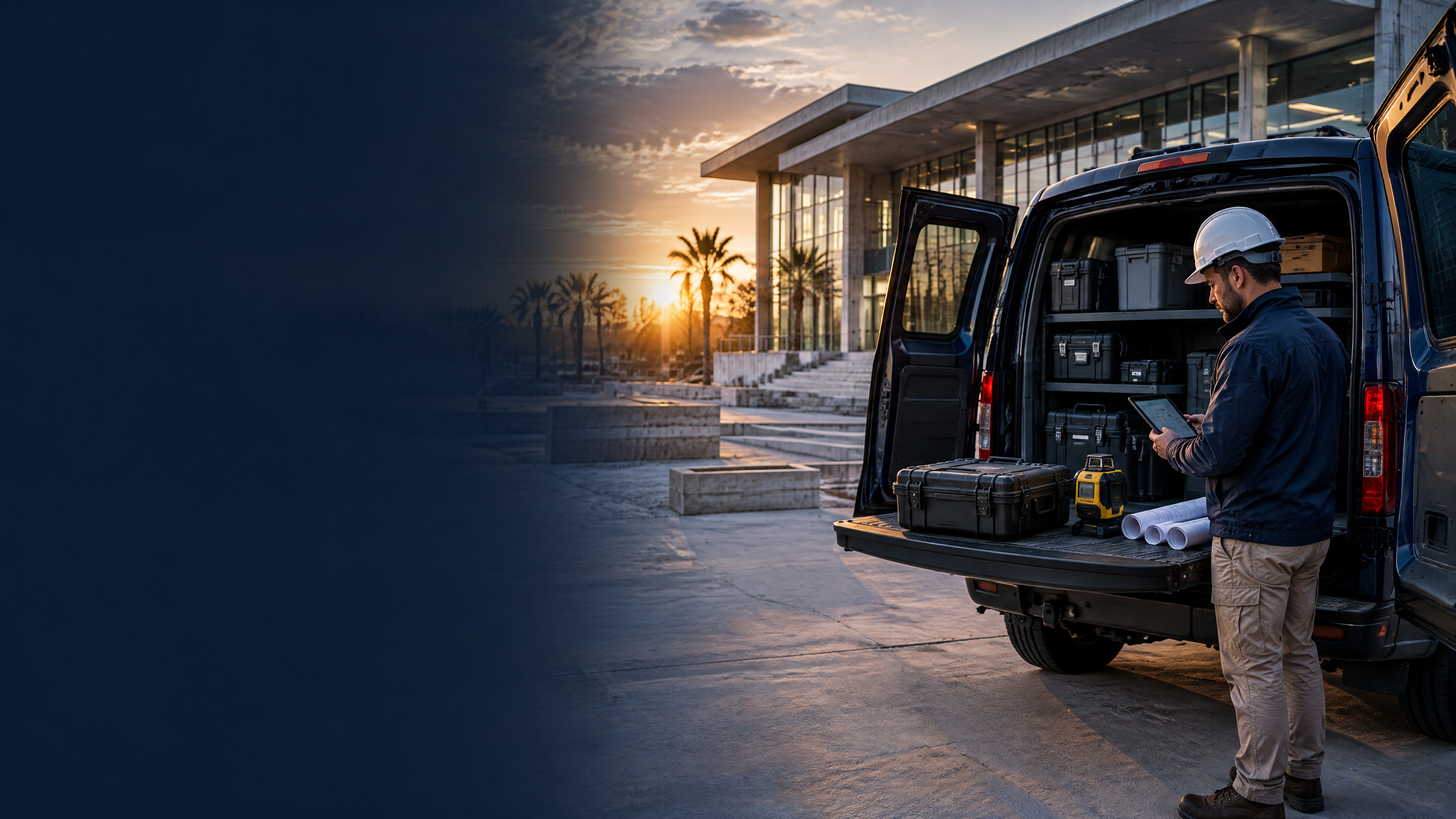
The van starts. The crew has an address. The tool cases in the back represent six years of purchases and tomorrow’s work.
Then one morning, the cases are gone. The van itself is still parked exactly where the driver left it.
A contractor may have a commercial auto policy and still need a separate answer for the loose equipment inside. The truck is a vehicle; the cases are business property. Their movement from a shop to a van to a jobsite may take them across different policy boundaries. A locked vehicle does not turn its contents into insured auto equipment.
Progressive Commercial’s current auto guidance makes the distinction concrete: a commercial auto form may cover permanently attached equipment such as built-in toolboxes, while loose tools and work materials may need inland marine coverage.[1] The precise result for any contractor still depends on the issued policies and the circumstances of the loss.
The better question is not “Do we insure the truck?” It is “Which policy follows the tools after they leave the shop?”
01One route, three coverage questions
Three places
a loss can land.
A contractor’s work often involves at least three insurance conversations. They should not be collapsed into one certificate or one premium.
| What is affected? | Starting point for review | Question the policy must answer |
|---|---|---|
| The work truck or van | Commercial auto | Is this vehicle insured for the particular liability or physical-damage loss? |
| Equipment kept at the scheduled shop | Commercial property or business personal property | What property is insured at this premises, at what value, and with what limits? |
| Loose tools moving between truck, temporary storage, and jobsite | Contractors’ equipment or tools-and-equipment inland marine | Which gear, locations, causes of loss, and owners are included? |
This is a map for asking questions, not a coverage determination. Policies can overlap in limited ways. A businessowners policy may contain restricted off-premises coverage; a contractors’ equipment form may have specific location, vehicle, or storage conditions. Florida’s Department of Financial Services emphasizes that commercial forms and endorsements vary and that business owners should consult the issued policy and their agent about particular coverage questions.[2]
02Vehicle ≠ loose property
Commercial auto protects the vehicle—
not automatically its cargo.
Commercial auto liability is generally concerned with covered claims arising from use of an insured vehicle. Collision and comprehensive coverage, if purchased, address covered damage to the vehicle itself. Those are important protections, but they do not automatically value or insure a loose generator, inspection camera, or set of cordless tools in the cargo area.[1]
Permanently attached equipment requires a different review from removable property. A built-in rack or fixed toolbox may be treated differently from the drill cases loaded into it. Read the vehicle form and any attached-equipment provisions rather than assuming the presence of comprehensive coverage answers both questions.[1]
Theft creates an especially clear distinction. If a thief takes only the tool cases, there may be no physical damage to the vehicle to trigger a vehicle claim. If the van itself is stolen with tools inside, the vehicle and the contents can still be evaluated under different coverage forms. Neither example proves that a particular claim is covered or excluded.
03Location and limits
The shop policy may
stop short of the site.
Commercial property insurance commonly addresses buildings and business contents at insured locations. Florida’s consumer guidance describes commercial property as protection for commercial buildings and contents against covered causes of loss, subject to the form and endorsements.[2]
Business personal property can include equipment kept at the business premises. But a policy written around the shop does not necessarily follow every saw or laptop on the highway or protect it throughout a temporary jobsite stay. Progressive Commercial distinguishes property kept at a business premises from assets stored or transported off-site and identifies inland marine as an option for the latter.[3]
Do not treat that general distinction as proof that an existing businessowners policy has zero off-premises coverage. Some policies include it, perhaps with a smaller sublimit or defined territory. The only useful answer is the one in the contractor’s actual form.
04Coverage that moves
“Inland marine” is about mobility,
not a boat.
The term sounds nautical. For a contractor, inland marine commonly describes insurance for movable business property. A contractors’ equipment form or tools-and-equipment floater can be designed to follow specified gear in transit, at jobsites, and during temporary storage.[4] [5]
That design is valuable because a tool does not spend its life at one address. An HVAC technician loads gauges at the warehouse, drives to a client, leaves a compressor at a controlled jobsite overnight, and takes a rented lift to a second project. Each handoff changes the practical risk and may change which conditions in the policy matter.
Travelers and The Hartford describe contractor equipment programs that can address owned, leased, rented, or borrowed equipment, subject to each insurer’s terms.[5] [6] Their examples do not mean that every floater covers all four ownership categories. Some forms may include only scheduled property. Others may allow blanket coverage for certain smaller items and require separate listing for high-value gear. There may be per-item limits, overall limits, unattended-vehicle conditions, storage requirements, theft restrictions, or geographic boundaries.
05Ownership, attachment and value
Five pieces of equipment
that deserve separate answers.
The removable tool case.
A collection of drills and meters may travel every day. Check whether small tools fall under a blanket limit, whether one case or item has a sublimit, and how a van left overnight is treated.
The high-value machine.
A skid steer, specialty diagnostic instrument, or laser scanner may exceed a blanket per-item limit. Ask whether it must appear on a schedule with its own stated value and identifier.
The rented or borrowed unit.
A rental agreement can make the contractor responsible for loss, but that promise does not itself create insurance. Check whether rented or borrowed equipment is covered, how soon it must be reported, and whether loss-of-use charges or continuing rent are addressed. Travelers and The Hartford show that these exposures may be insurable, not that every policy includes them. [5] [6]
The employee’s own tools.
An electrician might bring personal tools to work. Confirm who owns each item and whether employee-owned property is included, limited, or excluded. The Hartford describes some programs with employee-tool protection subject to limits. [6]
The fixed van installation.
A permanently mounted compressor, rack, or integrated vacuum system may be treated differently from a loose tool. Review its installation and value with both the auto and equipment insurer to avoid assuming that either form has picked it up. [1]
Materials intended to become part of a building create another category. Installation floaters and builders’ risk may address certain construction materials or work in progress; a contractor-equipment schedule should not be assumed to insure the project itself.[5]
06Triggers and exclusions
“Covered theft” has conditions;
“bad weather” is not one peril.
A policy may address theft, vandalism, fire, or accidental damage. That does not settle questions about an unlocked van, gear left in the open, missing keys, dishonest acts, or proof of a forced entry. Read the theft wording and storage conditions before making promises to a crew or client.
Weather needs the same care in Florida. One inland marine insurer may cover some weather losses; another form may exclude or restrict particular hazards, including flood, hurricane, or wind, unless an endorsement changes the result. Progressive Commercial describes typical exclusions in its program while Travelers lists weather events that may be included in its own program.[4] [5] Neither company’s marketing description is a substitute for SmittyShield reviewing the proposed form.
Coverage limits, deductibles, and valuation also shape the outcome. A $50,000 total limit may not help as expected if one expensive item is capped separately. A policy paying actual cash value may value an older tool differently from a form offering replacement cost. An ordinary wear-and-tear failure is not the same as a covered accidental loss.[3] [4]
Finally, replacing the tools does not automatically replace lost income while the crew waits. Business-income and equipment-rental extensions have their own triggers, waiting periods, conditions, and limits. Review them separately. For that distinction, see The Building Is Back. The Business Is Still Closed.
07Records that travel with the business
Build the tool list
before anything goes missing.
An equipment inventory has two jobs. It helps the agency estimate the values and categories to insure before a loss. It also gives a claims team a more usable record afterward.
The Hartford’s risk-engineering guidance recommends recording the manufacturer and model, serial number or other unique identifier, purchase date, storage and use location, and photographs for each item of equipment.[7] Include the owner and any rental-agreement obligations when relevant. A current replacement estimate and receipt can add context, though the policy—not the spreadsheet—determines valuation.
Store an accessible copy away from the only truck or jobsite tablet. A photograph of a case is helpful; an inventory that connects that case to identifiable contents is better. Update the list when a new crew arrives, an expensive rental is accepted, or a tool moves between jobs.
Security is a companion to insurance, not a substitute. A locked gang box, controlled key access, well-lit parking, and clear overnight procedures may reduce exposure. The Hartford stresses that no single measure eliminates theft.[7] Keep records of who had access and report a suspected theft promptly to the appropriate authorities and insurer under the policy’s conditions.
A 15-minute van-to-jobsite audit
Before the next workweek, ask one crew lead and one person responsible for insurance to follow a typical day’s equipment route.
List the load.
Name the high-value items, portable cases, equipment fixed to the vehicle, rented gear, and employee-owned tools. Assign each an owner.
Trace the locations.
Mark where each item sleeps: the shop, a truck, a customer’s premises, a jobsite box, a rented storage unit, or a team member’s home. Note which moves cross state lines.
Match the forms.
Compare the auto, commercial property, and inland marine documents. Find the covered-property definitions, territory, per-item and total limits, valuation, deductibles, theft conditions, and exclusions. Do not infer protection from a certificate alone.
Test one scenario.
Imagine that a locked van is intact but the loose cases are missing. Then test a jobsite theft and a separate weather loss. Ask which form would be presented for each item, subject to claims review.
Close the gaps.
List unanswered items for your insurance professional: high-value scheduling, rental reporting, employee property, overnight vehicle conditions, weather limitations, and any rental-of-replacement or income extension. Set a date to update the inventory.
08Ten-point first-pass review
Mobile-equipment
readiness check.
A useful first-pass review should be specific enough that a crew lead can answer it:
Does the policy follow the work?
Follow the route of the work
The gear moves.
The questions should move with it.
The useful insurance conversation starts with where the work actually moves. SmittyShield can help a contractor compare that route with the issued coverage forms, identify missing information, and review available options without treating a carrier brochure as a guarantee.
Explore general liability insurance for third-party claims (a different exposure), call (561) 606-0778, or email smithlaurent@smittyshield.org to review the property carried to work. If a project also requires contract insurance evidence, read The Certificate Says Insured. The Endorsement Decides What That Means.