
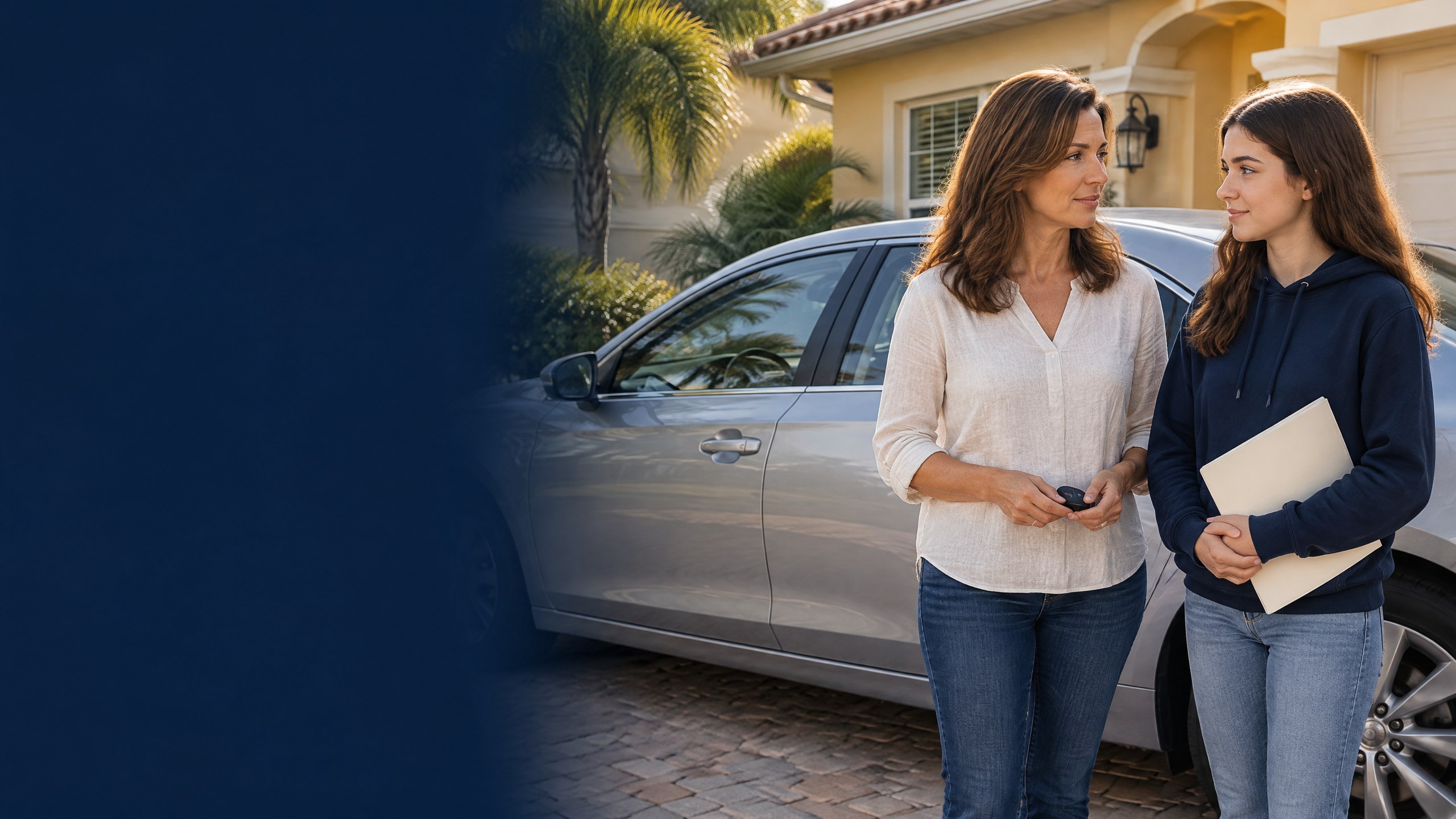
The first solo drive can be ordinary and enormous at the same time. A trip to school. A stop at practice. A parent watching the driveway longer than usual.
The family has prepared the driver. But has it updated the insurance conversation?
A car can appear on an auto policy while important questions about a new household driver remain unanswered. The permit stage, the license milestone and the vehicles your teen will regularly use deserve a clear review. An existing personal umbrella policy deserves attention too. A large limit is useful only when the people, activities and underlying coverage fit the policy's terms. [1] [4] [5]
This is not a reason to frighten a new driver. It is a reason to prepare before handing over the keys.
01Personal protection · Teen drivers
Start with the driver, not
just the car
Think about a hypothetical family whose teen has practiced in one parent's sedan. After licensing, the teen also begins using a second family vehicle. The policy renewal still looks familiar, so the parents assume nothing needs to change.
The better question is whether the insurer has the current facts about the household and the teen's regular access to both vehicles.
Travelers' driver-addition guidance identifies a teen with a learner's permit as one situation in which a household should discuss adding a driver. It also addresses people who regularly use household vehicles. The precise disclosure, listing and rating requirements depend on the insurer and the policy. Do not substitute a friend's experience for an answer about your own coverage. [1]
Contact the insurer or agent before practice begins, then revisit the arrangement when licensing or vehicle use changes. Ask what must be reported, how the teen should be shown on the policy and when a requested change takes effect. There is no universal notification grace period being promised here.
A screenshot showing an insurance payment is not the same thing as confirmation that a driver change has been processed. Retain the insurer's response and any revised policy documents.
02Personal protection · Teen drivers
A Florida learner-license rule has
a specific scope
Families sometimes hear that a learner's permit never changes the premium. That should not be treated as a universal Florida promise.
Florida Statutes section 627.746 addresses a particular situation: a named insured who is a caregiver of a minor under 18 in out-of-home care, as defined by Florida law. For that situation, the statute prohibits an additional premium for coverage of the minor while operating the insured private passenger vehicle during the learner-license period, until the minor obtains a driver license. [2]
That is a specific protection, not a blanket rule for every Florida household. It also is not a promise of unlimited coverage or permission to ignore the insurer's disclosure requirements. Families to whom the provision may apply should ask how it is implemented in their policy.
For any new driver, keep the insurance discussion separate from the licensing discussion. FLHSMV states that a learner's-license driver must always be accompanied by a licensed driver who is at least 21. Other graduated-license conditions also apply. Insurance does not replace compliance with those conditions. Use the official Florida teen traffic-law page to review the current rules for the teen's license. [6]
03Personal protection · Teen drivers
Repairing the family car is not the
whole liability question
A parent may look at the deductible and ask, “Could we afford to fix the car?” That is important. It is not the only possible loss.
Florida's insurance consumer guidance distinguishes liability for bodily injury or property damage to others from coverage purchased for damage to your own vehicle. Collision and other-than-collision coverage address different questions from liability coverage. [3]
Consider a hypothetical accident that damages another vehicle and injures its occupants. The repair bill for the family's car and the potential liability to other people do not draw on one interchangeable limit. A low collision deductible does not establish that the bodily injury liability limit is adequate.
Read the liability amounts on the declarations page, the document that summarizes the policy's principal coverages and limits. Ask how any per-person and per-accident limits apply. Ask about the property damage liability amount separately. Do not infer the scope of coverage from the phrase “full coverage.”
The coverage amounts to consider depend on the household's situation and the choices available. This article does not prescribe one limit for every parent, and it does not predict a claim payment.
04Personal protection · Teen drivers
Review the personal umbrella at
the same time
A personal umbrella policy can provide additional liability protection for covered claims beyond primary auto or property-policy limits. It may also provide defense-cost coverage under its own terms. It is not a larger collision deductible fund or a replacement for a properly arranged auto policy. [4] [5]
Ask whether the teen is an insured under the umbrella's definitions. Then ask which family vehicles and underlying policies must be disclosed or scheduled. A driver's status under an auto policy should not be treated as proof that every condition of a separate umbrella policy has been satisfied.
Underlying insurance means the primary coverage beneath the umbrella. Insurers can require particular underlying liability limits. Allstate's public description of its own personal umbrella product, for example, specifies qualifying primary coverage and required limits. That is a carrier's program requirement, not a universal limit schedule for every umbrella policy. [5]
For your household, request the applicable requirements in writing. Compare them with the auto policy that is actually in force. Ask what happens if the required primary coverage is missing or its limit is too low. Do not assume the umbrella will automatically fill that shortfall.
This is also a useful time to distinguish liability to others from protection for your own household. A personal umbrella generally does not pay to repair your own car, and its liability limit should not be mistaken for medical or uninsured motorist protection for your teen. Any such coverage question needs its own policy review. Business-related losses also commonly fall outside personal umbrella coverage, so describe any work use rather than assuming the family arrangement covers it. [4] [5]
A review does not require buying an umbrella in every case. It requires understanding what the household already has and whether another liability layer merits consideration.
05Personal protection · Teen drivers
Make the next milestone part
of the conversation
The arrangement at the first practice session may not match the arrangement a year later.
A teen may obtain a license, start regularly using another vehicle or acquire a car of their own. A household may change address. These are reasons to revisit the driver and vehicle information, rather than waiting for a renewal document to reveal an old assumption. Travelers recommends discussing the people who regularly access household vehicles and the information needed to add them. [1]
Ask about ownership and registration before deciding which policy should insure a newly purchased car. Describe the actual driving routine. If the teen starts using a vehicle for work or delivery, make that a separate coverage question. Do not label the use simply “school” if the facts have changed.
Discounts can be part of the discussion too. Good-student or other available discounts may depend on the insurer's eligibility rules. Ask about savings after establishing the correct driver information and protection, not instead of doing so. [1]
06Personal protection · Teen drivers
A 15-minute
family coverage review
First, have the current auto declarations page and any umbrella documents available. Identify the teen's license stage and the vehicles they can regularly access. Include any expected change to that use.
Next, separate the questions about liability to other people from questions about the family's own car. Note the deductible you would need to pay for a covered vehicle-damage claim. If an umbrella exists, compare its underlying requirements with the actual auto liability limits.
Finally, record the questions that need an insurer's answer. Keep the response and any issued changes together. Use a secure insurer or agency process for personal identifiers. Do not post a teen's date of birth, driver's license or permit image in a public comment or an ordinary website checklist.
The useful result is a clear list of facts and follow-up items. Completing this exercise does not bind, amend or confirm coverage.
07Personal protection · Teen drivers
Eight questions before the
next driving milestone
Prepare the driver.
Review the protection.
Use these questions as an interactive preparation checklist. A checked box means the question has been addressed; it does not mean the insurer has approved a driver, issued coverage or accepted a future claim.
08Personal protection · Teen drivers
The safety plan belongs beside
the insurance plan
A calm insurance conversation should support a calm driving conversation.
FLHSMV's teen-driving guidance recommends planning the route and GPS before departure, using seat belts and avoiding phone use or other distractions behind the wheel. It also warns against impaired and drowsy driving. Agree on these practices before the trip, not by sending a message that the teen feels pressure to read while driving. [7]
Use the FLHSMV teen-driving safety resource alongside the licensing rules. Neither a safety checklist nor an insurance policy guarantees that an accident will not happen. Both deserve thoughtful preparation.
09Personal protection · Teen drivers
Bring the driver and the policy to
the same conversation
Browse SmittyShield's coverage overview to prepare for the next conversation. For a different injury-protection question, read The Other Driver Has Insurance. Is It Enough?, which explains why uninsured and underinsured motorist choices deserve their own review.
To discuss a new household driver or a personal liability layer, start a coverage conversation. Describe the upcoming change without sending sensitive driver documents through a public form. Call (561) 606-0778 or email smithlaurent@smittyshield.org for the appropriate next step.
The first solo trip is a milestone for the whole family. Make sure the insurance conversation reaches that milestone too.