
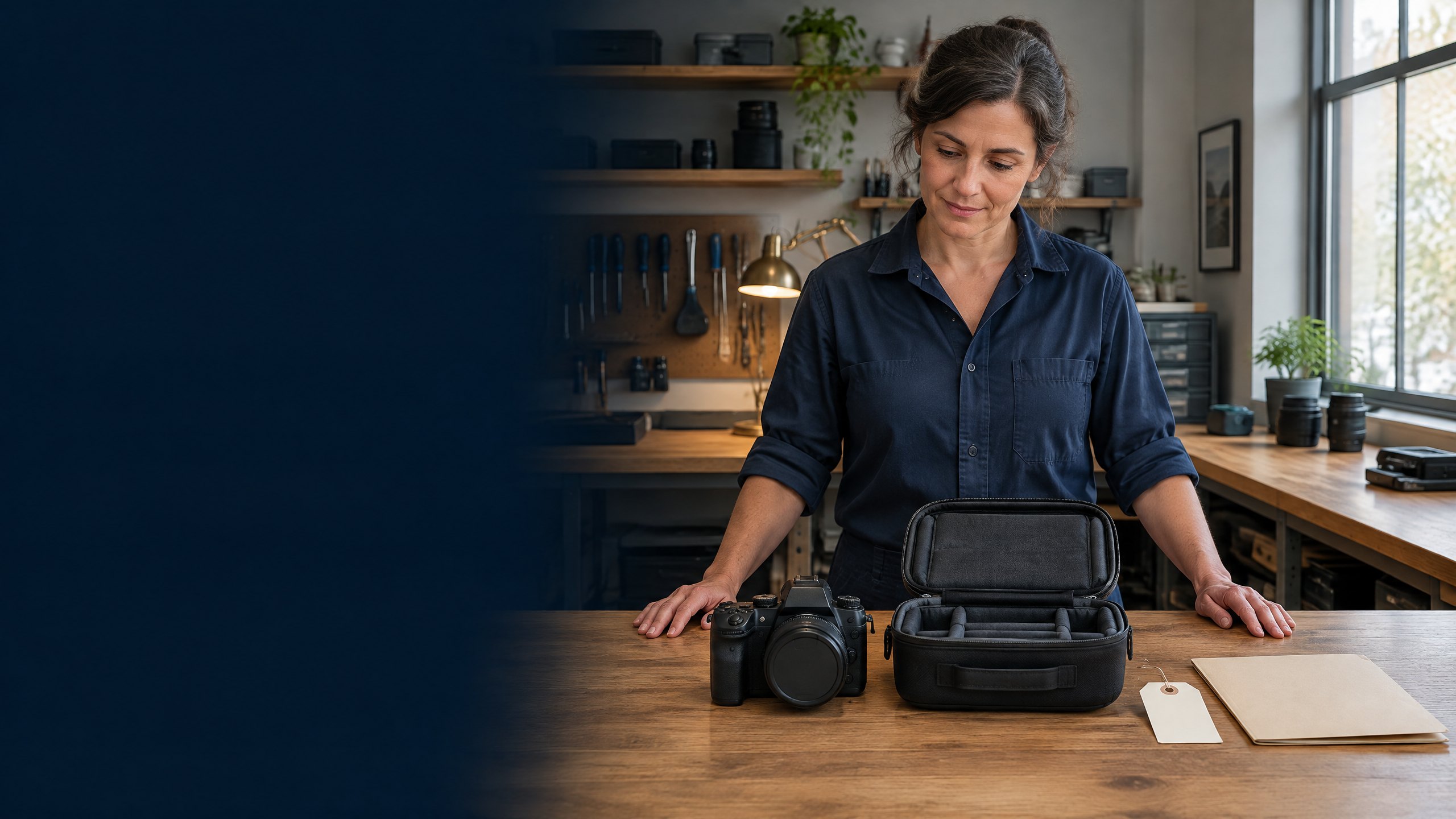
A customer leaves a camera at a repair shop. The owner writes a work order, places the camera on a shelf and schedules the inspection. The repair may be a small job. The camera itself may represent a much larger value.
Now imagine a break-in before pickup. This is a hypothetical situation, not an actual claim. The shop's tools and the customer's camera are missing. They were in the same room, but they do not necessarily fall under the same insurance protection.
General liability is not automatically insurance for a customer's property in your possession. Businesses that repair, clean or store other people's belongings need to review protection for the entrusted goods—not just the policy covering their own equipment or ordinary third-party liability. [1] [2]
01Business protection · Customer property
What “care, custody
or control” means
Care, custody or control describes the business's relationship with property it does not own. A cleaner holds a customer's coat. A repair shop keeps a device while working on it. A storage operation safeguards goods until the owner collects them. [1]
Many general liability policies contain an exclusion for damage to personal property in the insured's care, custody or control. An exclusion is wording that removes a specified risk from coverage. A customer can therefore own the damaged item and still face a situation outside the business's ordinary general liability protection. [1] [4]
This is not a rule that every loss involving someone else's property is excluded. The policy wording, endorsements and facts matter. Progressive explains that this particular exclusion generally concerns personal property rather than building structures or permanent fixtures. Other exclusions can apply to other work and property. This article focuses on movable goods a customer entrusts to a business; it does not determine coverage for damage to a building. [1]
The useful question is not simply whether the claimant is a customer. It is what property was damaged, how the business was holding or handling it, and which policy was written to respond.
02Business protection · Customer property
What bailee
insurance means
A bailee is a person or business entrusted with property owned by someone else. Bailee insurance addresses physical loss of or damage to those goods, or the business's legal responsibility for that loss, depending on the form. Warehouses and repair facilities are common examples of businesses with this exposure. [3] [4]
Coverage can be offered through an endorsement added to a businessowners policy, or through a separate property or inland marine policy. Inland marine is a commercial-property coverage category often used for movable goods and property in transit; it is not limited to boats. Travelers describes an optional Bailee's Customers Goods endorsement for service businesses, with protection for customer goods in the business's possession or in transit. That is a carrier example, not a feature automatically included in every businessowners policy. [1] [2]
The label alone does not identify every covered item, location or cause of loss. The actual policy must fit what the business accepts and does with it.
03Business protection · Customer property
Customer-goods coverage and legal-liability coverage
are different questions
Some forms focus on direct physical loss to the customer's goods. Others focus on the business's legal liability for a loss. Great American's bailee brochure presents customers' coverage and legal-liability coverage as separate options. [3]
A legal-liability form asks about the business's responsibility for the damage. A customers' property form asks about the insured goods and a covered physical loss. The evidence and coverage requirements are therefore not necessarily identical. A claim does not become payable simply because the item was handed over at the counter. [3] [4]
Ask the agent or insurer which approach the proposed form uses. Have the discussion before a loss, when there is time to compare the business's operations with the policy. Do not assume that every product called “bailee” provides the same direct-property protection or the same legal-liability protection.
Nor should the business assume a policy covers every mistake made during repair or processing. Ask specifically about damage caused while work is being performed, and how the form handles faulty work, testing or processing. The broader fact that the business repairs goods does not establish coverage for every way an item can be damaged. [3] [4]
04Business protection · Customer property
The goods need protection through
the actual route
A camera may arrive at the counter, move to a bench, spend several nights in storage and then leave with a courier. Coverage at the shop does not, by itself, establish coverage during every part of that route.
Travelers' service-business example includes customer goods in transit. Great American's brochure also describes the availability of coverage at third-party locations and in transit. Those descriptions are reasons to review the locations and movement in the actual form, rather than assume every policy follows the goods everywhere. [2] [3]
Explain who transports the goods, where they are stored overnight and whether an outside specialist receives them. Identify any location or movement that has been added since the policy was arranged. An insured work vehicle and insured customer cargo are different questions; a commercial auto policy should not be treated as proof that everything inside it is protected. [1] [2]
The cause of loss matters too. Falvey describes fire, theft and certain water or weather damage as common bailee exposures, while emphasizing that terms vary. Great American identifies flood and earthquake as optional coverage in its first-party customers' form. Do not treat a general reference to “water damage” as confirmation of flood protection. [3] [4]
05Business protection · Customer property
The repair fee is not the
value at risk
The business earns a fee for the service. The property it holds can be worth much more than that fee. Several customers' items can also be affected by the same fire or break-in. A coverage conversation needs to address the goods being held, not only the shop's service revenue.
Ask how the policy values the customer's property and what limits apply. Are there limits for an individual item, a location or goods in transit? How are seasonal peaks or unusually valuable items handled? Establish which deductibles and conditions apply instead of assuming one large headline limit settles every question. Commercial policy forms and endorsements vary, as Florida's Department of Financial Services emphasizes. [3] [5]
New-for-old replacement is not something to infer from the word “insured.” Great American, for example, describes a goodwill replacement endorsement as an optional feature with its own conditions. That illustrates why the settlement basis needs to be read, not guessed. [3]
Likewise, replacing the camera body does not recreate the customer's files. Damage to physical goods and exposure of customer information are separate risks. Travelers discusses customer-goods and cyber protection as different coverage choices for service businesses. A shop handling devices or sensitive information should not assume the physical-property policy answers the data question. [2]
06Business protection · Customer property
A receipt proves
possession, not insurance
An intake record can help establish what the business received and in what condition. It does not bind insurance, expand a policy limit or guarantee that a claim will be covered.
Travelers recommends consistent inbound and outbound documentation and detailed condition photos or videos on arrival and return in its mobile-equipment-dealer guidance. Those practices are useful to consider for other businesses receiving physical goods, but they are not a universal insurer requirement for every repair shop. [6]
The same distinction applies to inventory. Travelers' warehouse guidance recommends a current receipt-and-release record of stock. It warns that inadequate inventory management can make liability assessment or claim settlement more difficult after an incident. An item trail helps answer what was present; it does not decide whether the cause of loss is covered. [7]
Record the information that is useful and appropriate for the operation. The sources cited here do not require every business to collect a customer receipt, serial number or appraisal, nor do they prescribe a universal retention period. Customer documents and photographs still need appropriate privacy and security handling.
07Business protection · Customer property
Protect the goods while the insurance questions
are being answered
Coverage review does not replace safe handling and storage. Travelers' warehouse guidance supports controlled access to goods, current inventory records and suitable fire safeguards. Unsupervised pickup or drop-off can increase the risk of missing or damaged property. [7]
For a small service shop, the practical discussion might concern who can access the storage area, how staff identify the correct item at pickup and how equipment is protected after hours. The appropriate controls depend on the premises and the work. A warehouse's facility guidance is not a substitute for local requirements or a safety assessment of an individual shop.
If something is damaged or missing, document the situation and contact the insurer or agent through the policy's reporting process. Ask about the evidence and next steps before promising a payment or assuming a repair reimbursement is approved. Condition and inventory records are useful context, but the policy and loss facts still govern. [5] [6] [7]
08Business protection · Customer property
A 15-minute
customer-property review
Compare the wording with that route. Find the covered-property description and the limits. Establish whether the form addresses direct loss to the goods, legal liability or another arrangement. Review transit and outside locations. Ask about an item damaged during the work itself. [2] [3] [4]
Finally, compare the insurance discussion with the intake and pickup records. A file that clearly identifies an item and its condition can make the conversation more useful. Completing the review is preparation, not a coverage certification. [6] [7]
09Business protection · Customer property
Eight questions before the
next customer pickup
Use this checklist to prepare a conversation with the agent or insurer. A checked box means the question has been reviewed; it does not mean a claim, item or policy has been approved.
Trace the goods.
Review the protection.
10Business protection · Customer property
Review the goods, not just the
business's policy name
The customer owns the camera. The business controls where it goes while the work is being done. That relationship creates an insurance question that deserves its own answer.
For a related exposure, read The Truck Is Insured. What About the Work Inside It? to separate vehicle protection from the property it carries. The Certificate Says Insured explains why policy and endorsement wording matter more than a coverage summary.
Explore SmittyShield's coverage guidance or start a business coverage conversation. Call (561) 606-0778 or email smithlaurent@smittyshield.org. Describe the kinds of goods and the work first; arrange a secure channel before sending customer records or private documents.